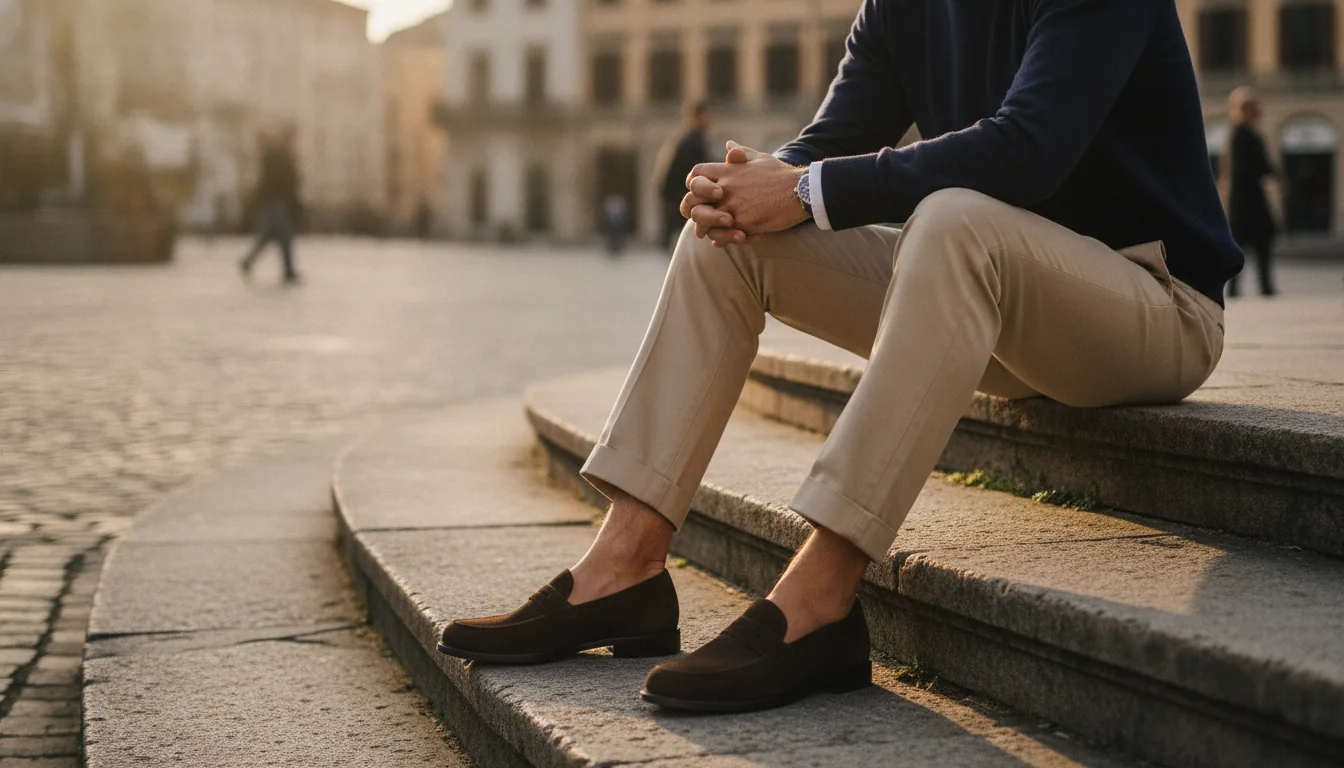
What to Wear Today: The Right Outfit in 5 Minutes

9 min readLast updated: October 27, 2026
What to wear today comes down to four questions in a fixed order: What does the weather feel like, which meeting matters most today, what dress code level does it call for and which color formula holds the outfit together. Answer them the night before, and in the morning you only check the forecast and get dressed in five minutes.
Get an outfit suggestion from your own closet every morning, matched to the weather. See the app
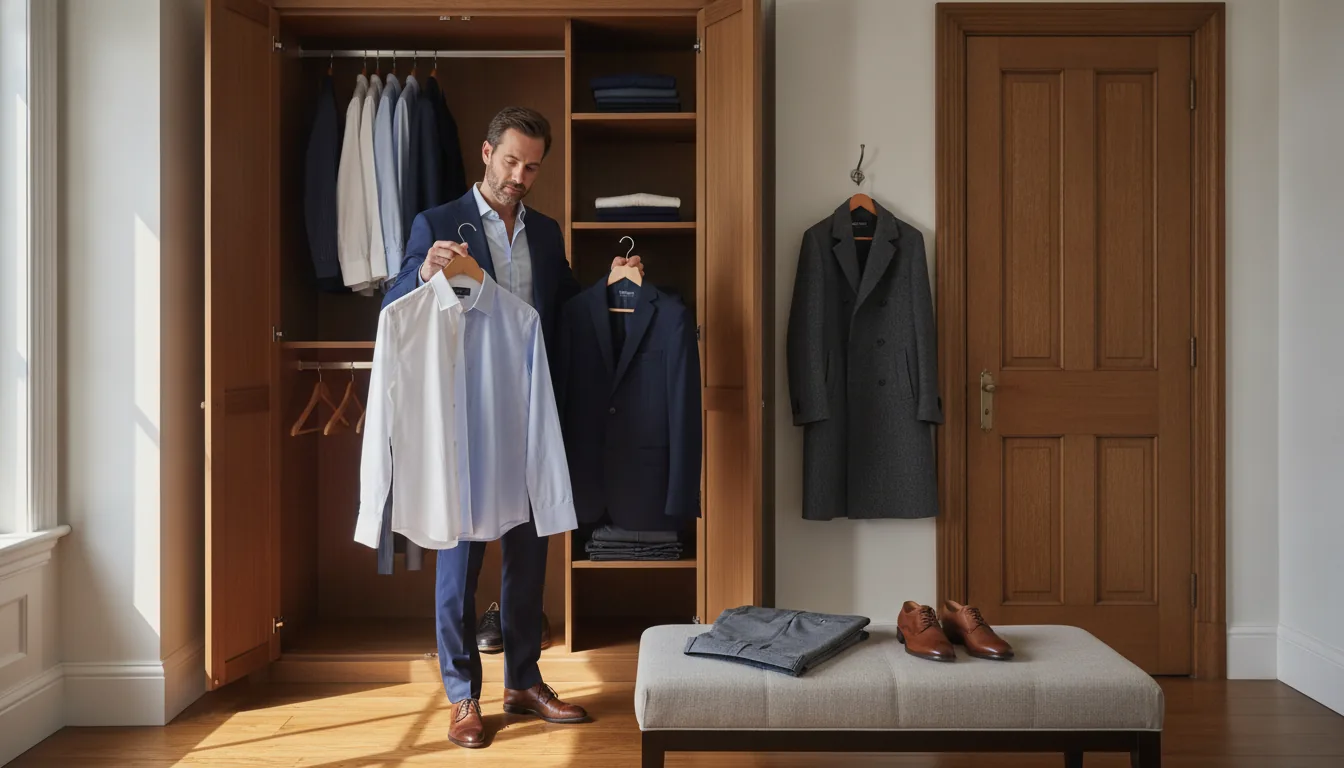
Four questions answer “What should I wear today?”
You can answer “What should I wear today?” with four checks in a fixed order. Each one narrows your options until a single outfit is left:
- Weather: The feels-like temperature and the chance of rain decide how many layers you need and which shoes.
- Meeting: The most important meeting of the day sets how formal the outfit has to be.
- Dress code: You translate that meeting into one of five levels, from casual to formal.
- Color: A simple color formula turns the right pieces into an outfit that looks put together.
The order matters. Weather and meetings are fixed, while dress code and color are your call. Start with your favorite shirt and check the forecast afterward, and you may end up changing twice.
Step 1: Read the weather by the feels-like temperature
The number on your weather app is only part of the answer. The National Weather Service defines apparent temperature as the perceived temperature, based on temperature combined with wind (wind chill) or with humidity (heat index). When the temperature drops to 50°F or below, the NWS uses wind chill. Above 80°F, it uses the heat index. In between, the apparent temperature equals the air temperature.
For your outfit, that means one thing: Dress for the feels-like number. On a windy 45°F morning, your coat has to handle a day that feels colder than the forecast headline. Many weather apps show the feels-like value right next to the measured one.
Look at the whole day, morning and afternoon
In the fall, mornings often run much colder than afternoons. If you leave the house at 7:30 a.m. in the low 40s and sit in a client meeting at 3 p.m. in the low 60s, your outfit has to handle both. The answer is thin layers: a shirt, a fine merino sweater over it, the blazer on top and a light coat for the commute. Each layer comes off on its own.
Rain decides your shoes and your coat
Rain changes two pieces: You wear leather shoes with rubber soles and a trench coat or a light rain jacket. Everything else stays as planned.
Here’s my rule of thumb for office days, based on the feels-like temperature in the morning:
| Feels-like temperature | Layers | Shoes |
|---|---|---|
| below 40°F | wool topcoat, heavy sweater or turtleneck under the blazer | rubber-soled leather shoes, boots |
| 40 to 55°F | topcoat or quilted vest, merino sweater | leather shoes |
| 55 to 65°F | blazer or overshirt, light sweater you can take off | leather shoes, loafers |
| 65 to 75°F | shirt, unlined blazer | loafers, leather sneakers |
| above 75°F | linen or lightweight cotton | loafers |
The table assumes a commute with some walking or public transit. If you drive from one parking garage to the next, go one level lighter. If you spend a lot of time outdoors, say on a job site or at a trade show setup, go one level warmer and pick weatherproof shoes.
Step 2: Your most important meeting sets the outfit
After the weather, open your calendar and find the most important meeting of the day. The first meeting is often the wrong benchmark. If you have an internal stand-up at 9 a.m. and a client presentation at 4 p.m., the presentation decides the outfit.
Clothes reach people before your words do. In a series of nine studies, researchers from Princeton and New York University showed participants headshots and asked them to rate each person’s competence (Oh, Shafir and Todorov, Nature Human Behaviour, 2020). The same face was rated significantly more competent when paired with clothes that looked “richer.” The effect held when the images flashed by for just 129 milliseconds and when participants were told outright to ignore the clothing.
One outfit, several meetings: The blazer as a dial
Most days have more than one meeting. A good outfit handles the most important one and dials down for the rest. The blazer is your main tool: on for the client, on the back of your chair for the team huddle. The same goes for the tie. So plan from the top down: The most formal piece of the day goes into the outfit, and everything else adjusts around it.
Days without meetings: Dress for yourself
On a remote workday or a day with no outside meetings, you set the bar yourself. I recommend level 2 of the dress code scale below: dark chinos, an oxford shirt or fine knit and clean leather sneakers. It’s comfortable at your desk and ready for a surprise video call or a last-minute coffee with a client. Sweatpants and an old T-shirt simply push the decision to the moment your phone rings.
Step 3: Translate the dress code into a level
Dress codes sound complicated, yet they boil down to five levels. Match your most important meeting to a level, and the core pieces are set:
| Level | Typical occasion | Core pieces |
|---|---|---|
| 1 Casual | weekend, gym, errands | jeans, T-shirt or sweatshirt, sneakers |
| 2 Smart casual | happy hour, dinner with friends | dark jeans or chinos, shirt or sweater, loafers or leather sneakers, blazer optional |
| 3 Business casual | regular office day, workshop | wool trousers or chinos, dress shirt, blazer, leather shoes |
| 4 Business professional | client meeting, presentation, negotiation | suit or blazer with wool trousers, dress shirt, tie depending on industry, leather shoes |
| 5 Formal | gala, evening wedding | dark suit or tuxedo, per the invitation |
When in doubt, go one level up. You can take off a blazer in seconds when everyone else is in sweaters. If you show up at the client’s office without one, there’s nothing you can do.
Factor in the industry and the people across the table
The same level looks different across industries. Business professional at an investment bank means a dark suit and tie. At a tech startup, it often means a blazer with an open collar. Take your cue from the people you’re meeting: For a client meeting, dress as formally as the client or one notch above. If you don’t know the culture, check the team photos on the company’s website. You’ll see in seconds whether anyone wears a tie.
Step 4: A color formula turns pieces into an outfit
Weather, meeting and dress code have picked your pieces. Color now decides whether they read as an outfit. One simple formula covers almost every day:
- One dark base color for the blazer or trousers, such as navy, charcoal or dark brown.
- One light contrast color for the shirt, such as white, light blue or ecru.
- No more than one accent, like a rust sweater, a burgundy tie or an olive overshirt.
- Shoes and belt in one color family: brown with brown, black with black.
Contrast controls the effect. Navy with white looks crisp and formal, which is why it works for the client meeting. Gray with light gray or khaki with ecru looks calm and relaxed, a good fit for the workshop or casual Friday.
Three examples from a typical closet:
- Client meeting: Navy suit, white dress shirt, burgundy tie, brown derbies with a brown belt.
- Office day: Gray wool trousers, light blue oxford shirt, navy blazer, brown loafers.
- Casual Friday or workshop: Khaki chinos, ecru sweater, olive overshirt, white leather sneakers.
Keep patterns to one piece
In the color formula, patterns count as an accent. A fine-striped shirt, a glen check blazer or a patterned tie adds depth, as long as you stick to one patterned piece. If you wear two patterns, make them clearly different in scale: a fine stripe in the shirt with a bold check in the blazer. For level 4 and 5 meetings, stick with quiet, small-scale patterns.
Decision fatigue: What the research actually shows
Almost every article on morning routines mentions Barack Obama. In 2012, he told author Michael Lewis that he wore only gray or blue suits to pare down his decisions (Vanity Fair, “Obama’s Way”). Behind that sits an idea from psychology known as ego depletion. The model describes self-control as a limited resource that effort drains. That gave rise to the popular claim that every small decision in the morning uses up willpower for the rest of the day.
The research on this is sobering, and you should know it before you justify an outfit system with it:
- 2016: 23 labs with a combined 2,141 participants repeated a standardized ego-depletion experiment. The measured effect was so small, d = 0.04, that its confidence interval included zero (Hagger et al., Perspectives on Psychological Science).
- 2021: 36 labs with 3,531 participants tested the effect again, this time with two different experimental procedures. The preregistered tests found no significant result, d = 0.06, and the data were four times more likely under “no effect” than under the expected effect (Vohs et al., Psychological Science). Exploratory analyses hinted that the effect was larger for participants who reported more fatigue.
Read honestly, that means a willpower tank that measurably drains when you choose between a white and a blue shirt is not supported by the evidence. Anyone promising that a fixed outfit system will make you more productive at work is selling more than the studies deliver.
Why a fixed routine still pays off
There are better reasons for a morning routine than ego depletion. Three of them hold up without a disputed theory:
- Time: A decision you made the night before costs you zero minutes in the morning.
- Calm: The night before, you match meetings and weather without time pressure. At 7:15 a.m., you grab the first shirt you see.
- Impact: If clothes shape how competent you look within milliseconds, the most important meeting of your day deserves an outfit you chose on purpose.
The personal uniform: Who it works for
Some men take Obama’s approach all the way and wear the same combination every day, such as a navy blazer, white shirt and gray trousers. That works well when your days rarely change dress codes. When client meetings, workshops and evening events alternate, the uniform hits its limits. Then the four-question routine gets you there faster, because it fits each day as it comes.
The morning routine: Decide the night before, check in the morning
The fastest answer to “What should I wear today?” comes the night before. The routine has four steps:
- Step 1, night before: Open your calendar and flag the most important meeting of the next day.
- Step 2, night before: Check the forecast for morning and afternoon, including the feels-like temperature and the chance of rain.
- Step 3, night before: Lay out the complete outfit, shoes, belt and socks included.
- Step 4, morning: Take a quick look at the latest forecast. If it holds, get dressed. If it has changed, switch to plan B.
Plan B almost always involves just two pieces. If it rains unexpectedly, swap your shoes for a rubber-soled pair and grab the trench coat. If it’s colder than expected, add a merino sweater under the blazer.
On Sunday night, run the same routine for the whole week. A look at your weekly calendar shows which days have client meetings and when a quiet office day comes up. Spread your strongest pieces across the most important meetings, and check that everything is clean and pressed. That way, you spot the stain on your favorite shirt on Sunday evening.
The same principle works across several days on the road. My business trip packing list shows how to set outfits for a whole trip ahead of time and pack your carry-on from them. The more coherent your closet, the faster the routine runs. A closet built from interchangeable core pieces, as described in the guide to the capsule wardrobe for men, leaves little room for color mistakes.
An outfit suggestion from your own closet, every morning
The routine gets even shorter when someone else makes the first suggestion. That’s why I built maiasa, the AI outfit planner. You take one photo of each piece, and the AI recognizes and sorts it for you. From there, Google’s Gemini 3 model curates an outfit from your own clothes every day, matched to your style and the weather. You can also plan outfits days in advance, for example for a week packed with client meetings.
Full disclosure: maiasa is developed in Germany and compliant with the EU’s GDPR. The free version includes every feature with one outfit suggestion per day, and Premium with unlimited suggestions comes with a 7-day free trial. For an overview of other options, see my roundup of the best wardrobe apps.
Bottom line: “What should I wear today?” gets answered by weather, meeting, dress code and color, in exactly that order. Decide the night before, check briefly in the morning, and your outfit is ready in five minutes.
Frequently asked questions
How do I decide what to wear quickly in the morning?
The fastest way is to answer four questions in a fixed order: weather, most important meeting, dress code level and color formula. Answer them the night before and lay out the full outfit, shoes and belt included. In the morning, you only check whether the forecast has changed.
What should I wear when the weather keeps changing?
Wear several thin layers: a shirt, a merino sweater, a blazer and a light coat. That way you adjust by taking a layer off or putting one on. If rain is possible, pick leather shoes with rubber soles and a trench coat.
Is decision fatigue real?
The idea that willpower is a limited resource that small decisions drain is disputed in psychology. Two large replication projects with 23 and 36 labs, published in 2016 and 2021, found no reliable effect. A fixed morning routine still saves you time.
Should you lay out your clothes the night before?
Yes, it pays off. The night before, you have time to check your calendar and the forecast calmly, and in the morning there's nothing left to search for. Lay out shoes, belt and socks along with the shirt and trousers.
What colors always go together in menswear?
Navy, gray and brown paired with white and light blue form a base that almost always works. A simple formula: one dark base color, one light contrast color and no more than one accent. Keep your shoes and belt in the same color family.
Sources
- National Weather Service: National Digital Forecast Database Definitions, weather.gov, accessed October 2, 2026
- DongWon Oh, Eldar Shafir, Alexander Todorov: Economic status cues from clothes affect perceived competence from faces, Nature Human Behaviour 4, 287 to 293, March 2020
- Michael Lewis: Obama’s Way, Vanity Fair, October 2012
- Martin S. Hagger, Nikos L. D. Chatzisarantis et al.: A Multilab Preregistered Replication of the Ego-Depletion Effect, Perspectives on Psychological Science 11, 546 to 573, 2016
- Kathleen D. Vohs, Brandon J. Schmeichel et al.: A Multisite Preregistered Paradigmatic Test of the Ego-Depletion Effect, Psychological Science 32, 1566 to 1581, October 2021
All links checked on October 27, 2026.