What to Wear to a Job Interview as a Man: Match the Dress Code

9 min readLast updated: October 10, 2026
For a job interview, men should dress one step above the company's everyday dress code. In finance and consulting that means a suit and tie, in most corporate offices a suit or a blazer, in tech a blazer with chinos. Research the dress code ahead of time and try on the full outfit three days before the interview.
Plan your interview outfit days ahead from the clothes you already own. See the app
Dress one step above the job you’re interviewing for
A job interview is a meeting where you show respect for the people across the table. The Texas A&M University Career Center puts the rule simply: Candidates should dress a little more conservatively and formally than employees typically dress at that organization. That rule works in every industry because it starts with the company you are visiting.
Here’s what one step up looks like in practice:
- If the team works in button-downs without jackets, wear a blazer.
- If blazers and dress trousers are the norm, wear a suit.
- If suits without ties are standard, add the tie.
Your interview outfit is the best version of what you would wear on the job.
Business professional and business casual, decoded
American career centers sort interview clothes into two dress codes. Knowing the vocabulary helps when a recruiter tells you what to expect.
| Dress code | What it means for men | Typical interview setting |
|---|---|---|
| Business professional | Two-piece suit and tie, solid neutral colors, dark shoes with dark socks | Finance, law, consulting, government, most large corporations |
| Business casual | Tie optional, sport coat or blazer appropriate but not required, collared shirt | Many corporate offices, mid-size companies, some tech roles |
The descriptions follow Texas A&M’s guidance. The Temple University Career Center adds an important note: Business casual is the most common dress code in offices, and it may be too casual for most formal job interviews. Temple calls business professional the standard dress code for a job or internship interview. In other words, the everyday office dress code is usually one step below what you wear to the interview.
Clothes shape first impressions in a fraction of a second
A study from Princeton shows how fast clothing works. DongWon Oh, Eldar Shafir and Alexander Todorov asked participants in nine studies to rate the competence of faces (Nature Human Behaviour). The same faces were rated as more competent when the person wore clothing that independent judges had rated as looking “richer.” The effect showed up when the images were shown for just 129 milliseconds. It held even when participants were warned that the clothes said nothing about the person and were told to ignore them.
For your interview, that means: You prove your skills with answers, examples and sharp questions. Your outfit decides the first picture the interviewer has in mind while listening to them.
When in doubt, go one notch dressier
You can take off a blazer in two seconds if your interviewer is in shirtsleeves and invites you to. You cannot add a blazer you left at home. Being slightly overdressed is the safer mistake. The limit is the point where the outfit looks like a costume: A three-piece suit with a pocket square at a startup sends a message nobody asked for.
How to research the company dress code
Most companies show the world how their people dress. A short check before the interview gets you to a clear answer:
- Study the careers page: Look for candid team photos and office shots. Formal headshots are often dressier than an ordinary Tuesday.
- Look up your interviewers on LinkedIn: Their names are usually in the invitation. Event photos and conference talks tell you more than profile pictures.
- Scroll the company’s social media: Trade shows, team events and behind-the-scenes posts reveal the real dress code.
- Ask the recruiter: Texas A&M says it is perfectly appropriate to ask the person scheduling your interview about the company dress code, and the UNC Charlotte Career Center notes that it is fine to call HR and ask. One line does it: “Is there a dress code I should plan for?”
- Confirm the format: A plant tour, a lunch interview or a full day of panels changes what you need from your shoes, fabrics and comfort.
From signal to outfit
Your research will almost always point to one of five signals. This table turns each signal into an outfit.
| What you see | Everyday dress code | Your interview outfit |
|---|---|---|
| Suits and ties in team photos | Business professional | Navy or charcoal suit, tie, black oxfords |
| Blazers and button-downs, no ties | Business casual | Suit without a tie or blazer with wool trousers, tie optional |
| Button-downs or sweaters, chinos, sneakers | Smart casual | Blazer, open-collar shirt, chinos, leather shoes |
| Workwear, shop floor, job sites | Functional | Button-down or polo, chinos, sweater, clean leather shoes |
| Invitation says “come casual” | Relaxed | Smart casual with a blazer or overshirt |
“Come casual” almost always means polished smart casual. Hoodies, shorts and gym sneakers stay at home.
What to wear to a job interview by industry
Every industry has its own range. The chart places five typical settings on a ladder that runs from shirt to blazer, suit and tie.
Finance, consulting and law: suit and tie
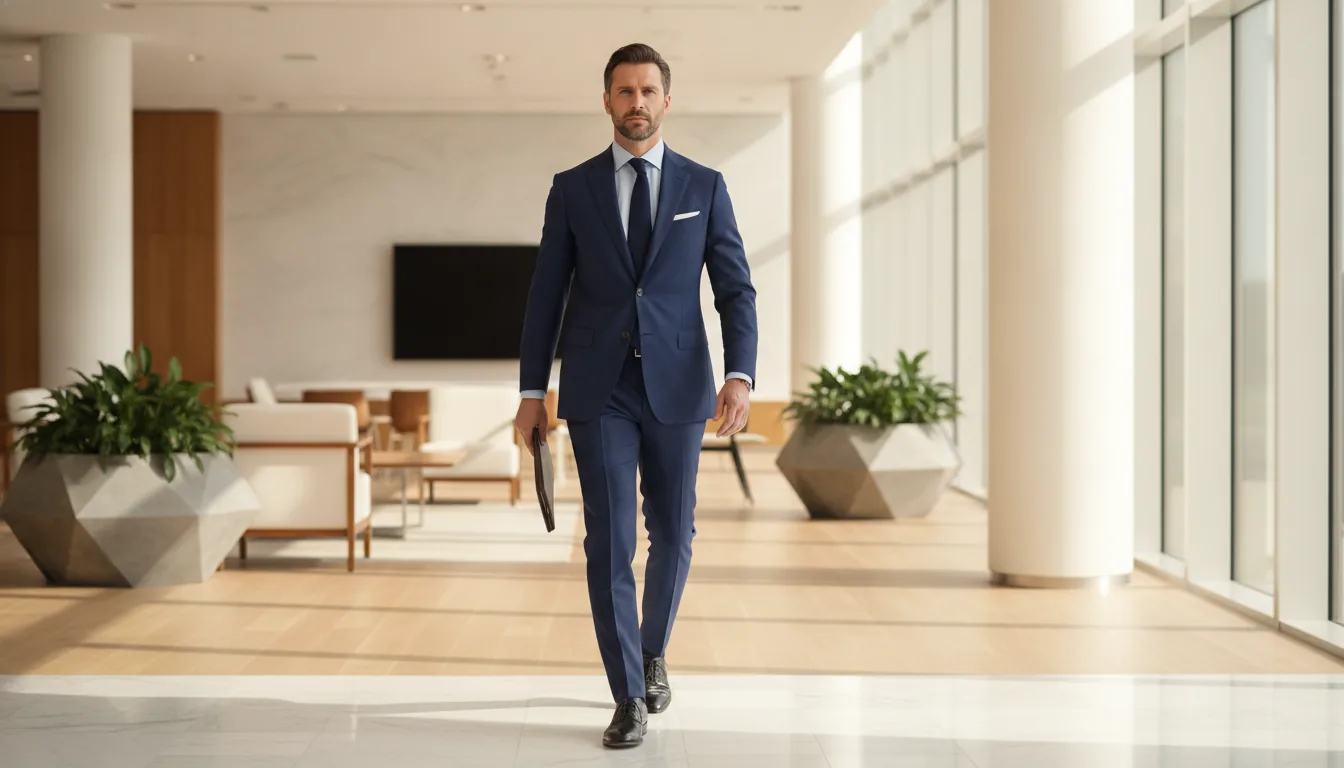
In conservative industries, a suit and tie is the expected baseline. Texas A&M describes business professional for men as a two-piece suit and tie in solid, neutral colors. I reach for navy or charcoal because both look calmer than black during the day and work with more shirts and shoes.
The complete outfit has seven building blocks:
- Suit in navy or charcoal, solid or with a subtle texture
- Shirt in white or light blue, pressed, with a collar that sits cleanly under the lapels
- Tie in a muted color, solid or with a small pattern
- Shoes: Black leather oxfords, freshly polished
- Belt matching your shoes, with a plain buckle
- Socks in a dark color, long enough that no skin shows when you sit
- Watch with a simple leather or metal band
Corporate offices and manufacturing: suit or blazer
Mid-size companies and manufacturers cover a wide range. Leadership may wear suits, office teams business casual and the plant floor workwear. Let the role decide your step: For a client-facing or management position, wear the suit. For a specialist role in the office, a blazer with wool trousers often hits the mark.
Decide on the tie based on what your research showed. If your interviewers wear ties in their photos, wear one too. If a plant tour is on the agenda, choose smooth leather shoes with rubber soles: They look sharp in the conference room and grip on a factory floor.
Tech and startups: blazer, open collar, chinos
At tech companies and startups, everyday clothes are often casual. One step up for your interview is a smart casual outfit with a blazer:
- Unstructured navy blazer or a wool overshirt
- Oxford button-down with an open collar, or a fine-gauge sweater
- Chinos in khaki, olive or gray, or dark jeans with no fading or rips
- Derbies, loafers or clean white leather sneakers
I break down how smart casual works and where it tips into weekend wear in my guide to the smart casual dress code for men. A suit and tie can feel distant in this setting. A blazer without a tie shows that you made an effort and that you understand the culture.
Sales and the skilled trades: polished and on the customer’s level
In the trades and technical roles, workwear is built for function. A professional appearance still counts at the interview. A pressed button-down or polo, chinos, a sweater on cool days and clean leather shoes meet that expectation. If the interview includes time in the shop or on site, ask whether you should bring boots.
Sales follows its own rule: Dress the way you would for your most important customer. If you will call on industrial buyers, wear a suit, often without a tie. If you will sell luxury products, match the look of the showroom. Your interviewer is asking one silent question: Can I send this person to our client tomorrow? Your outfit helps answer it.
A video interview needs an outfit built for the camera
Texas A&M advises following the same dress code for a virtual interview as you would in person. The camera adds three requirements of its own.
Solid colors look calmer on screen
The Career Success Center at Western Connecticut State University warns against busy patterns like pinstripes or plaid because the lines look like they are moving. The same center advises against white, which can look far too bright with a webcam and lighting, and against all-black outfits. That leaves you with an easy formula:
- Shirt: Light blue or soft off-white, solid
- Jacket: Navy or medium gray, solid or with a very fine texture
- Tie, if the role calls for one: Solid navy, burgundy or green
Lighting and camera position are part of the outfit
WCSU recommends placing a light behind your computer at eye level so your face is lit without shadows, and says sitting with a window in front of you is the best option. Raise the camera to eye level so you look straight ahead. A calm background, such as a plain wall or a tidy bookshelf, lets your outfit do its work.
Get dressed from head to toe
The pants count too. If you wear sweatpants with a blazer, you sit differently, you feel different, and you risk an awkward moment if you have to stand up to close a window. Shoes on your feet help you sit up straighter as well.
Final rounds, all-day interviews and working interviews
Many hiring processes involve more than one meeting. Each format asks something different of your outfit.
The second round: same level, different outfit
In a second round you often meet the same people again. Stay at the same level of formality and change the pieces: a different shirt, a different tie, different trousers with a blazer. If the first round showed you were a notch too formal, step back by half a level, for example by skipping the tie.
The all-day interview: an outfit that lasts until five
A full day of panels, case presentations and lunch with the team demands clothes that still look good after hours of sitting. Wool wrinkles less than pure cotton or linen. Your shoes have to be comfortable because you’ll stand to present. A spare shirt in your bag is cheap insurance for lunch.
The working interview: dress like it’s your first day
In a working interview or trial shift, you show how you will show up every day. The real everyday dress code fits here, clean and polished. In the trades, that means functional clothes and safety boots if the employer requires them. Ask ahead whether gear will be provided.
The details that make or break the look
An expensive suit loses its impact when the details are off. Check these six points before every interview:
- Fit: The jacket’s shoulders end at your shoulders, a little shirt cuff shows below the jacket sleeve, and the trousers break cleanly over the shoe.
- Shoes: Polished, with intact heels and clean edges. When you sit, the interviewer often sees them longer than your shirt.
- Belt: UNC Charlotte’s rule is that belts should match the color of your shoes. Black with black, brown with brown.
- Socks: Dark, solid and long enough for sitting. Texas A&M pairs dark shoes with dark socks.
- Shirt: Pressed, with a clean collar. Pick up shirts from the cleaners two days ahead.
- Grooming: Fresh haircut, trimmed beard, clean nails, little or no fragrance.
Plan your interview outfit three days ahead
Most outfit problems happen on the morning of the interview: a stain on the shirt, trousers that got tight, shoes nobody has polished since the last rainstorm. A fixed routine prevents all three:
- Step 1, three days out: Put on the full outfit, including shoes, belt and socks. That leaves time for the dry cleaner, a tailor or a replacement.
- Step 2, two days out: Polish your shoes, press or pick up your shirt, choose your tie.
- Step 3, the night before: Lay everything out, check the forecast, plan a coat and umbrella in case of rain.
- Step 4, the day of: Build in ten minutes of buffer to check your collar, tie and shoes before you walk in.
If you’ve built your closet as a capsule wardrobe for men, this part is easy: A navy blazer, wool trousers, oxford shirts and leather shoes are already at its core.
Plan the outfit days in advance with maiasa
I use my own app for this kind of planning. With maiasa, the AI outfit planner, you take one photo of each piece, and the AI recognizes it and sorts it into your digital closet. From there, Google Gemini 3 curates an outfit from your own clothes that fits your style and the weather. You can lock in Thursday’s interview outfit on Monday and spot early whether anything needs a trip to the cleaners.
Full disclosure: I built maiasa. It’s developed in Germany and compliant with the EU’s GDPR. The free version includes every feature with one outfit suggestion per day, and Premium with unlimited suggestions comes with a 7-day free trial.
The short version: Research the dress code, dress one step above it and try on the full outfit three days ahead. Then your full attention in the interview belongs to the questions.
Frequently asked questions
Should a man wear a tie to a job interview?
Wear a tie for interviews in finance, law, consulting, government and most large corporations. In tech, startups, creative fields and the skilled trades, a tie is usually unnecessary. If your research leaves you unsure, bring one in your pocket and decide in the lobby.
What color suit is best for a job interview?
Navy and charcoal are the safest suit colors for an interview. Both read as professional, work with white and light blue shirts, and pair with black or dark brown shoes. Choose a solid fabric or a very subtle texture.
Can men wear jeans to a job interview?
Dark, clean jeans with no rips or fading can work for interviews at startups, creative agencies and in the trades, ideally with a blazer or a crisp button-down. For finance, law, government and most corporate roles, wear dress trousers or a suit.
What should a man wear to a video interview?
Wear the same outfit you would wear in person, from head to toe. Solid colors look calmer on camera than pinstripes or small checks, which can appear to move on screen. A light blue shirt under a navy blazer is a reliable choice.
Is it better to be overdressed or underdressed for an interview?
Slightly overdressed is the safer mistake. You can take off a jacket or a tie if the room is casual, but you cannot add one you left at home. Stay within reason, though: A three-piece suit at a startup sends the wrong signal.
Sources
- DongWon Oh, Eldar Shafir, Alexander Todorov: Economic status cues from clothes affect perceived competence from faces, Nature Human Behaviour, December 9, 2019
- Texas A&M University Career Center: Dress for Success, Texas A&M University, accessed October 2, 2026
- Temple University Career Center: Interview and Workplace Attire, Temple University, accessed October 2, 2026
- UNC Charlotte Career Center: Professional Attire, University of North Carolina at Charlotte, accessed October 2, 2026
- Western Connecticut State University, Career Success Center: Video Interviewing, WCSU, accessed October 2, 2026
All links checked on October 10, 2026.