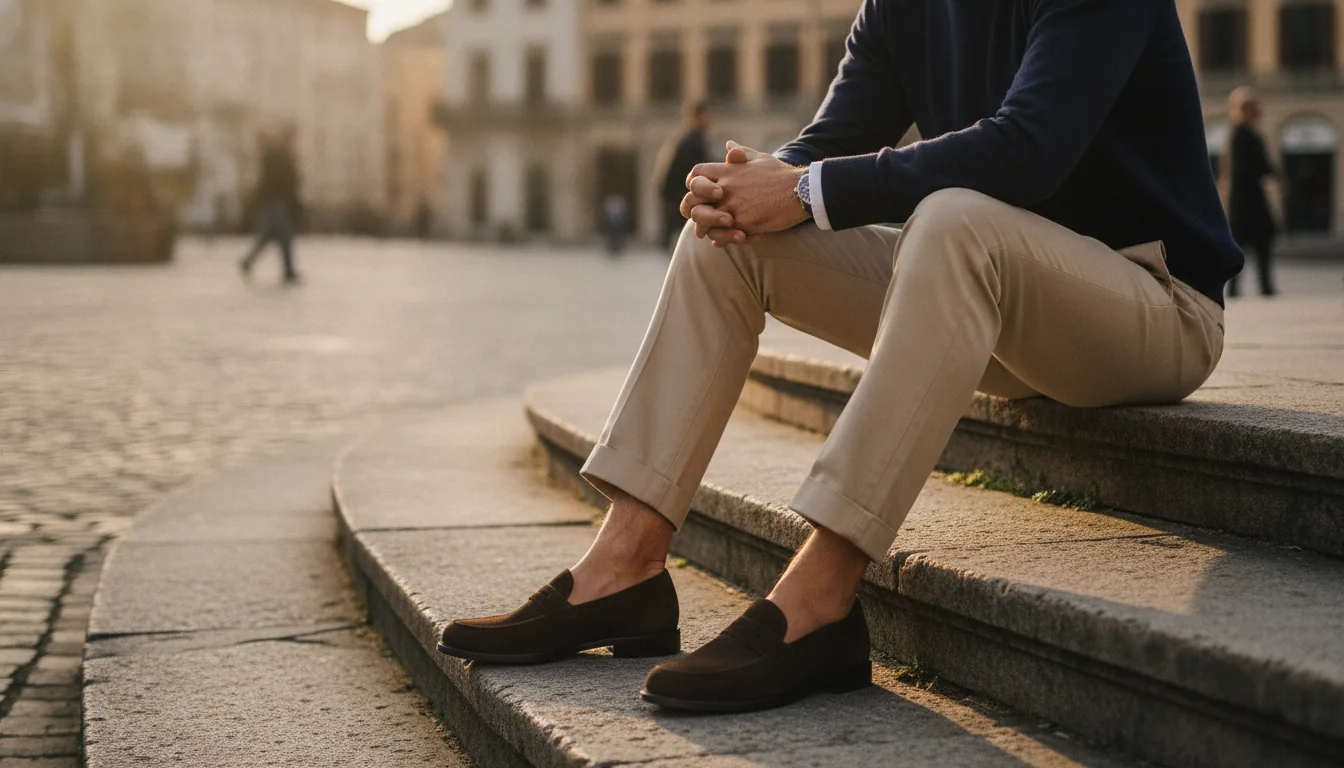
What Shoes to Wear With a Suit: Style, Color and Occasion

9 min readLast updated: October 13, 2026
The right shoes for a suit are smooth leather dress shoes: Oxfords with closed lacing are the dressiest, derbies the most versatile, and monk straps and loafers belong to more relaxed settings. Black goes with charcoal and black suits, dark brown with navy and gray. Match your belt to your shoes and your socks to your trousers.
Check your own closet to see which shoes already work with which suit. See the app
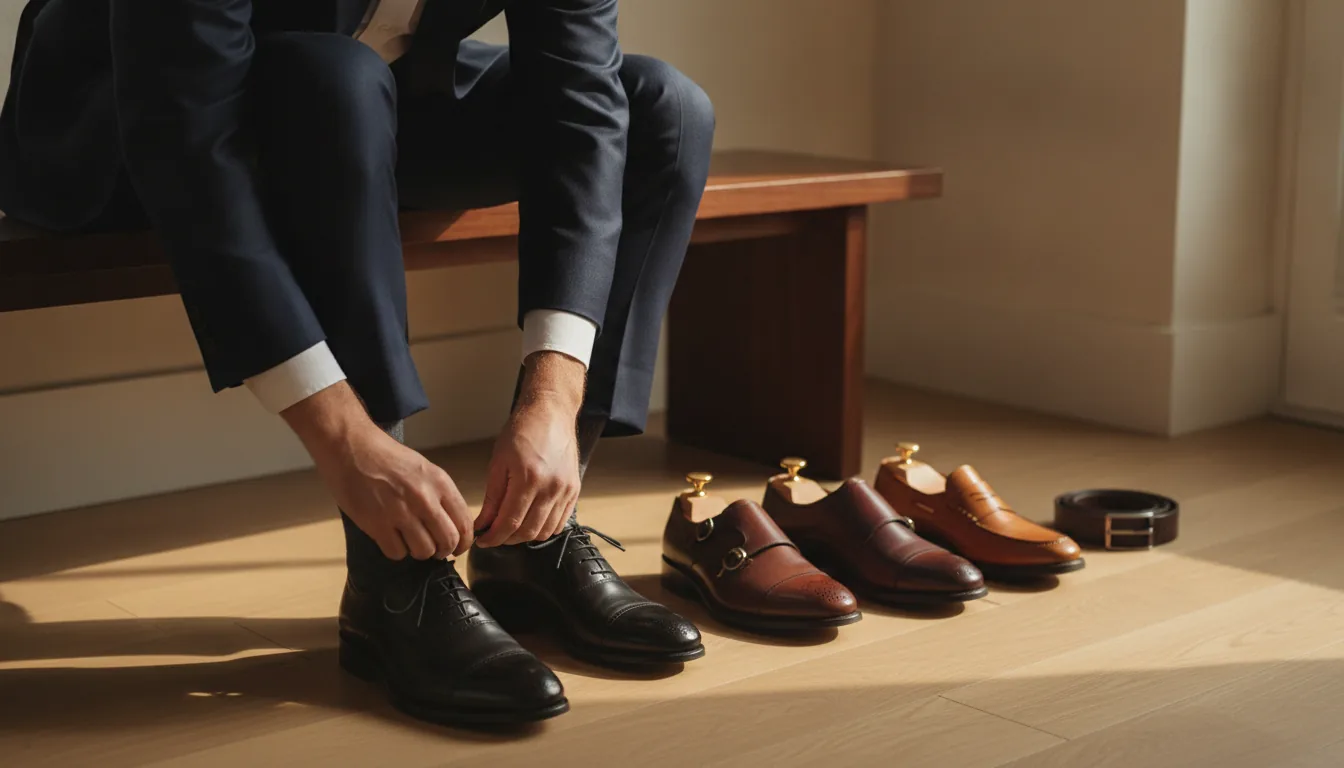
A suit calls for smooth leather shoes with a slim sole
What shoes to wear with a suit comes down to three things: the style, the color and the detailing. The sleeker the shape, the more closed the lacing, the darker the color and the smoother the leather, the dressier the shoe. That’s why a black oxford with no broguing sits at the top of the scale and a tan suede loafer near the bottom.
Your suit sets the starting point. A dark business suit asks for a dressy shoe. A light linen suit can handle a relaxed one. Once that logic clicks, you no longer need a list of rules: You simply check whether your shoes and your suit sit on the same level.
Three questions help every time you get dressed:
- How formal is the occasion? Interviews, funerals and evening events sit at the top, a regular office day in the middle, summer parties and weekends at the bottom.
- What color is the suit? Dark suits take dark shoes, and lighter suits can take lighter shades of brown.
- What’s the texture of the fabric? Smooth worsted wool wants smooth calfskin. Flannel, tweed and linen can handle broguing and suede.
Oxford, derby, monk strap, loafer: four styles, four levels of formality
The four classic suit shoes differ mainly in how they close. Learn to read the lacing, and you can read the formality.
The oxford: closed lacing, maximum formality
On an oxford, the eyelet tabs are stitched underneath the vamp. This closed lacing pulls the two sides together into a clean V. According to Wikipedia’s entry on the oxford shoe, closed-laced shoes are considered more formal than derbies and bluchers with open lacing. In the US, the oxford also goes by the name balmoral. Its name likely traces back to the “Oxonian,” a half boot that became popular at Oxford University around 1800.
The most common version is the cap-toe oxford, with a straight line of stitching across the toe. A black cap-toe oxford is the shoe I recommend to every man as his first pair for suits. It works with any dark suit, at an interview, a funeral and a formal dinner.
The derby: open lacing, maximum versatility
On a derby, the eyelet tabs are stitched on top of the vamp, so a small gap stays open between them when you lace up. This is open lacing. The Gentleman’s Gazette places the derby between casual shoes and the oxford: dressier than loafers, less formal than oxfords, and formal enough to look right with most suits. In the US, the closely related blucher is common. The same guide traces its name to the Prussian field marshal Gebhard von Blücher, who wanted boots his soldiers could pull on faster.
The derby is the shoe for men who want one pair for suits, blazers and chinos. In smooth dark brown calfskin, it works at the office, at client meetings and with jeans on the weekend. Open lacing also opens wider, which helps men with a high instep.
The monk strap: a buckle in place of laces
A monk strap closes with one buckle (single monk) or two (double monk). The Gentleman’s Gazette calls it an intermediate formal shoe that is incredibly versatile, pairing well with business casual and less formal business attire such as navy and gray suits. It is not suited for black tie or white tie. The guide recommends brown for a first pair and black only if you wear a lot of charcoal and gray suits. For banking, law and funerals, stick with the oxford.
The loafer: no laces, for lighter suits
A loafer is a slip-on, either as a penny loafer with a leather strap across the top or as a tassel loafer. The Gentleman’s Gazette calls loafers a business casual must-have. With suits, I keep them to light, unstructured and summer suits in linen, cotton or tropical wool. With a dark business suit, choose a lace-up.
Broguing lowers the formality
Brogues carry decorative perforations along the toe cap and seams. A full brogue with a W-shaped toe cap is what most Americans call a wingtip. The more perforations a shoe carries, the more casual it reads. A quarter brogue with a single line of holes along the cap still works with a business suit. A wingtip pairs better with flannel, tweed and sport coats.
| Style | How to spot it | Formality | Wear it with |
|---|---|---|---|
| Oxford | closed lacing | high | dark suits, tuxedo (in patent), funerals |
| Derby | open lacing | medium to high | business suits, blazers, chinos |
| Monk strap | one or two buckles | medium | navy or gray suits, business casual |
| Brogue (wingtip) | perforations | medium to low | flannel, tweed, sport coats |
| Loafer | no fastening | low | summer and linen suits, blazer and chinos |
Match your shoe color to your suit color
For color, the rule is: Dark suits take dark shoes, and the lighter the suit, the lighter the shade of brown it can handle. Black is the most formal shoe color, dark brown the most versatile.
| Suit color | Safe bet | Adds character | Best avoided |
|---|---|---|---|
| Navy | black, dark brown | burgundy, tan | |
| Medium gray | black, dark brown | burgundy, tan | |
| Charcoal | black | dark brown | tan |
| Black | black | any brown | |
| Tan, light gray | tan, light brown | dark brown | black |
| Brown | dark brown | tan | black |
Black: the most formal shoe color
Black shoes work with black, charcoal, gray and navy suits. With a black suit, they’re the only option. Sven Raphael Schneider of the Gentleman’s Gazette puts it plainly: Don’t wear a black suit with brown shoes. For interviews, funerals and formal evening events, black is never wrong.
Dark brown: the all-rounder for navy and gray
Dark brown pairs with most suits. Schneider writes that black works well with a navy suit, while cordovan, tan and dark brown shoes also look magnificent. With charcoal, he calls dark brown a nice alternative to black, and with medium and light gray he recommends dark to mid-brown shades. A navy suit with dark brown derbies reads a little warmer and more personal than the same suit with black oxfords.
Burgundy and tan: color with character
Burgundy, also sold as oxblood or cordovan, is a deep red-brown. It looks sharp with navy and gray suits and brings more personality than black. Tan, a light brown, belongs with lighter suits in tan, light gray or light blue. Schneider notes that light tan shoes with a navy suit make you stand out visually, which is worth keeping in mind if you prefer a quieter look.
“No brown in town”: an old rule, retired
You may have heard “no brown in town” or “no brown after six.” The Gentleman’s Gazette traces these rules to the 19th century, when gentlemen wore black footwear in the city, and says they have been outdated since the 1950s. Brown shoes are now widely accepted in town and in the evening. Schneider still recommends black as the fail-safe option when you’re in doubt, and light tan is rarely the best choice at night.
Belts and socks follow your shoes
Shoes never work alone. Your belt and socks decide whether the outfit looks pulled together.
Your belt matches your shoes
The UNC Charlotte Career Center puts it in one line: Belts should match the color of your shoes. Three details make the match work:
- Same shade: A dark brown belt with dark brown shoes, a tan belt with tan shoes. Schneider adds that your belt doesn’t have to be the exact same leather, but it should come as close as possible.
- Same finish: Smooth leather with smooth leather, suede with suede.
- Matching metal: The Gentleman’s Gazette suggests matching a monk strap’s buckle to your belt buckle, cufflinks and tie bar.
The same thinking extends to a leather watch strap. If your trousers have side adjusters or you wear suspenders, skip the belt. Then the shoes carry the leather color on their own.
Socks: long, solid and as dark as your trousers
The Texas A&M University Career Center pairs dark shoes with dark socks for business professional dress. In practice, that means solid socks that match your trousers or run a shade darker:
- Navy suit: navy or dark blue socks
- Gray suit: charcoal or black socks
- Black suit: black socks
- Brown or tan suit: brown or dark olive socks
Choose mid-calf or over-the-calf socks so no skin shows when you sit and cross your legs. Fine patterns such as pin dots or ribbing are fine at the office when the base color matches your trousers. For interviews and funerals, stay solid.
Chelsea boots and sneakers with a suit
Two shoe types keep showing up in modern suit outfits: boots and sneakers. Both can work when the suit and the occasion allow it.
Chelsea boots: the fall and winter option
A Chelsea boot is an ankle boot with elastic side panels. With a slim business suit, choose smooth black or dark brown leather with a slim sole, and make sure the shaft disappears cleanly under your trousers. Suede Chelsea boots belong with flannel suits and weekend outfits.
Sneakers: only with light, casual suits
Opinions split on sneakers. The Gentleman’s Gazette argues that leather sneakers with a suit are too much of a clash in formality and sees them, at most, in offices that keep relaxing their business casual standards. My line: I wear clean white leather sneakers without logos with a light, unstructured suit at a summer party or in the city. With a dark business suit, at client meetings and interviews, I wear leather dress shoes.
How to spot good dress shoes: leather, sole and fit
The best style only works when the quality holds up. You can check four things yourself in the store:
- Leather: Smooth calfskin with an even surface takes cream and wax well and develops a patina over time. Patent leather belongs with a tuxedo, suede with more relaxed suits.
- Sole: A leather sole looks elegant and breathes. For rainy days and long walks, a thin rubber sole or a leather sole with a rubber heel insert is more practical.
- Construction: Welted shoes can be resoled once the sole wears through, so a good pair stays in service far longer.
- Fit: The heel sits snug, your toes have a little room, and the instep doesn’t pinch. Try dress shoes on in the afternoon, wearing the socks you’ll wear with your suit.
Which shoes to wear for which occasion
The occasion decides where you enter the formality ladder. The table covers seven common situations.
| Occasion | Shoe style | Color |
|---|---|---|
| Job interview | Oxford or plain derby | Black, dark brown with navy |
| Office and client meetings | Derby, oxford, monk strap | Black or dark brown |
| Your own wedding | Oxford or patent oxford | Black |
| Wedding guest | Derby or monk strap | Dark brown, chestnut |
| Funeral | Oxford without broguing | Black, low shine |
| Black tie | Patent leather oxford | Black |
| Summer wedding in a linen suit | Loafer | Tan, light brown |
For black tie, the Gentleman’s Gazette notes that oxfords are traditionally preferred, though derbies have been worn with black tie in parts of Continental Europe. If you’re putting together a full outfit for a hiring meeting, my guide on what to wear to a job interview as a man walks you through it step by step.
Three pairs cover almost every suit
A man who wears suits gets by with a few well-chosen pairs:
- Black oxford: for interviews, funerals, evening events and every dark suit
- Dark brown derby: for navy and gray suits at the office, plus blazers and chinos
- Brown monk strap: as a personal accent with navy and gray
If you wear a lot of light suits or travel often in summer, add a tan loafer. In a capsule wardrobe for men, these shoes form part of the core anyway.
Care adds years to every pair
Good dress shoes last for many years when you take care of them. I never wear the same pair two days in a row so the leather can dry out, and I put cedar shoe trees in after every wear. Once a month the shoes get cream in a matching color, and before important meetings a little wax on the toe. Have worn heels replaced at the cobbler before the damage reaches the sole.
See which shoe goes with which suit in maiasa
I plan my own outfits with my app. With maiasa, the AI outfit planner, you take one photo of each suit and each pair of shoes, and the AI recognizes the pieces and sorts them into your digital closet. Google Gemini 3 then curates an outfit from your own clothes every day, matched to your style and the weather. You can plan outfits days ahead and know on Sunday which shoes need polishing for the week.
Full disclosure: I built maiasa. It’s developed in Germany and compliant with the EU’s GDPR. The free version includes every feature with one outfit suggestion per day, and Premium with unlimited suggestions comes with a 7-day free trial.
The short version: black oxfords for formal occasions, dark brown derbies for everyday wear, a belt that matches your shoes and socks that match your trousers. Follow those four rules and your shoes will work with every suit you own.
Frequently asked questions
Can you wear brown shoes with a black suit?
No, a black suit calls for black shoes. Brown creates a harsh contrast with black and makes the suit look unsettled. Brown shoes shine with navy, medium gray, tan and brown suits.
What color shoes go best with a navy suit?
Black and dark brown are both safe choices with a navy suit. Burgundy and tan add character and work for less formal occasions. For an interview, a funeral or an evening event, go with black.
Can you wear sneakers with a suit?
Clean white leather sneakers can work with a light, unstructured suit in tan or light gray at a relaxed event. With a business suit at the office, at client meetings or in interviews, wear leather dress shoes.
What color socks should you wear with a suit?
Wear solid socks that match your trousers or go a shade darker, such as navy socks with a navy suit and charcoal or black socks with a gray suit. Choose mid-calf or over-the-calf socks so no skin shows when you sit.
Does your belt have to match your shoes?
Yes. Your belt should be the same color as your shoes: black with black, brown with brown. Try to match the finish too, smooth leather with smooth leather and suede with suede.
Sources
- Wikipedia contributors: Oxford shoe, Wikipedia, accessed October 2, 2026
- E.J. Daniels: The Derby Shoe & Blucher Guide, Gentleman's Gazette, July 26, 2023
- Gentleman's Gazette: Monk Strap Shoes & Double Monks Guide, Gentleman's Gazette, January 7, 2022
- Sven Raphael Schneider: How To Wear Brown Shoes & Boots For Men, Gentleman's Gazette, September 21, 2023
- Gentleman's Gazette: Business Casual Shoes Guide, Gentleman's Gazette, September 21, 2022
- Texas A&M University Career Center: Dress for Success, Texas A&M University, accessed October 2, 2026
- UNC Charlotte Career Center: Professional Attire, University of North Carolina at Charlotte, accessed October 2, 2026
All links checked on October 13, 2026.