Business Casual Dress Code for Men: Sharp at Work, No Tie Required

9 min readLast updated: October 17, 2026
Business casual is the office dress code one step below a suit: a collared shirt, chinos or dress pants, a blazer or fine knit and leather shoes, with no tie. It covers a normal workday with colleagues and clients. Jeans, sneakers and polos depend on your company and are the exception.
Snap a photo of your work wardrobe once and see how many business casual outfits it already holds. See the app

Business casual is the office dress code one step below a suit
Business casual is a workplace dress code that sits one level below a suit and tie. The Emily Post Institute describes it as a slight step down in formality from the norm in professional settings. For men, its list is short and specific: a seasonal sport coat or blazer with slacks or khakis; a dress shirt, casual button-down, open-collar or polo shirt; an optional tie; loafers or loafer-style shoes, and socks. Jeans, Emily Post adds, are usually a no, and sneakers usually a no-go. Leather shoes are probably the safest bet.
That gives you a clear formula. Business casual for men means a collared shirt, chinos or dress pants, a blazer or fine knit and leather shoes, without a tie. The outfit has to hold up when a client walks in unannounced. What separates it from business professional is easy to see: The tie comes off, and the blazer is allowed to hang on the back of your chair.
Business casual started as Casual Friday
The dress code has a well-documented origin. According to Levi Strauss & Co., the company mailed a “Guide to Casual Businesswear” to roughly 25,000 HR managers across the country in 1992. The guide taught companies what relaxed office clothing should look like, with advice such as keeping wrinkled, stained or dirty clothing out of the workplace. In 1992, 20% of companies allowed casual dress every day. By 1995, that share was 33%, and another 42% allowed it one day a week. Nine out of ten companies had a casual dress policy by then. Casual Friday became the business casual workweek most offices know today.
Business casual is now the most common way Americans dress for work
Gallup has tracked how American workers dress since 2002. In its 2023 poll, four findings stand out for men:
- Business casual leads. 41% of U.S. workers say business casual is their typical attire, up seven percentage points from 2019. Casual street clothes follow at 31%, uniforms at 23%.
- The suit is a rarity. Only 3% of workers wear business professional clothing, the lowest share Gallup has measured. Just 3% of men regularly wear a suit to work.
- Men are split. Roughly a third each wear business casual, such as a shirt and slacks, casual street clothes or a uniform.
- Remote work pushed the shift. Workers who have ever telecommuted are more than twice as likely to wear business casual as those who haven’t, 58% versus 24%.
Gallup’s own bottom line fits on a sticky note: The real choice today is between degrees of casual. Business casual has gained at the expense of the suit.
For you, that means business casual is the baseline, and for client meetings you add one layer of formality on top.
Business casual vs. smart casual: The workday decides
Business casual and smart casual get mentioned in the same breath. The Emily Post Institute’s attire guide lists them as separate codes, with business casual for work and dressy casual for social occasions. Business casual is the dress code for a workday with colleagues and clients. Smart casual covers dinners, happy hours and private invitations; the guide to the smart casual dress code for men shows what works there.
| Element | Business casual | Smart casual |
|---|---|---|
| Occasion | office day, client meeting without suit requirement | dinner, happy hour, party |
| Goal | look competent and approachable | look polished and personal |
| Blazer | expected or within reach | optional |
| Colors | navy, gray, white, light blue, brown | also earth tones, texture, accent colors |
| Jeans | depends on the company, rare with clients | dark and clean usually works |
| Shoes | derbies, brogues, loafers | also leather sneakers, suede |
In short: Business casual is calmer and more predictable. When you walk into a meeting in business casual, you should read as competent first; your personality shows in the details.
The business casual starter wardrobe
About 14 pieces cover a full workweek in business casual. Use the list as a checklist against your own closet.
| Category | Count | Recommendation |
|---|---|---|
| Shirts | 5 | poplin and oxford in white and light blue, one fine stripe |
| Knitwear | 2 | merino sweaters in navy and gray, a turtleneck for winter |
| Pants | 3 | gray wool dress pants, khaki or navy chinos, flannel pants or a second pair of chinos |
| Blazers | 2 | navy plus one gray or brown, both working with all three pants |
| Shoes | 2 | brown derbies or brogues, loafers in brown or dark brown |
Add a brown leather belt and a simple watch. If you want to build your entire closet around this principle, the guide to the capsule wardrobe for men walks you through the system.
Shirts: a collar that stands up
The shirt carries business casual. Without a tie, the collar does double duty: A spread collar or a button-down collar stays crisp when worn open and doesn’t collapse under the blazer. White and light blue work with every pair of pants and every jacket. A fine stripe adds variety without breaking the calm of the outfit.
Knitwear: the layer between shirt and blazer
Fine knitwear is the most flexible piece in a business casual closet. A crew-neck merino sweater over a collared shirt replaces the blazer on office days and still looks put together, because the collar stays visible. A merino turtleneck goes under a blazer and makes the shirt optional in winter. Weight matters: Thin, fine-gauge knits belong in the office, chunky cable knits belong to the weekend.
Pants: wool and chinos
Gray wool dress pants are the dressiest business casual piece and work with any blazer. Chinos are the relaxed option for office days without outside meetings. Both should be slim without being tight, with a length that just breaks on the shoe.
The blazer: your switch between office and client
The blazer decides how formal your business casual outfit reads. A navy wool blazer lifts any shirt and any pants to client level. If your company allows denim, a blazer also makes dark jeans office ready; the guide on how to wear a blazer with jeans shows how to get the balance right.
Shoes: brown leather
Brown derbies, brogues and loafers are the business casual shoes. Black oxfords look too stiff with chinos and belong with a suit. White leather sneakers pass in many offices when they’re spotless, but they stay home on client days.
Business casual do’s and don’ts at a glance
| Building block | Do | Don’t |
|---|---|---|
| Shirt | poplin, oxford, open collar | short-sleeve shirt under a blazer, big logo |
| Tie | leave it off for the daily office | tie with chinos and sneakers |
| Knitwear | merino, turtleneck, knit polo | hoodie, graphic sweatshirt |
| Pants | wool dress pants, chinos, flannel | cargo pants, shorts, joggers |
| Jeans | dark, with a blazer, only if your company allows it | light wash, rips |
| Blazer | wool in navy, gray, brown | shiny suit jacket worn on its own |
| Shoes | derbies, brogues, loafers | sandals, running shoes, flip-flops |
| Fit | blazer fits at the shoulders, pants end at the shoe | baggy cuts, sleeves too long |
Business casual has three levels
Business casual is a range with three levels. Your calendar decides which one you need: Who are you meeting today?
- Client day: blazer, collared shirt, wool pants, leather shoes. This level sits just below a suit and is your default whenever someone from outside the company is in the room.
- Office day: collared shirt, fine knit on top, chinos, loafers. The blazer hangs within reach.
- Internal day: knit polo or a shirt without a sweater, chinos, leather sneakers where your company allows them. This level fits team days and Fridays.
Five business casual outfits for the workweek
A typical week mixes all three levels. These five outfits come from the 14 pieces in the starter wardrobe.
Monday, client meeting: navy blazer, light blue shirt, gray wool pants
A Monday client meeting calls for the top level. Navy blazer, light blue poplin shirt, gray wool dress pants, brown derbies, brown belt. This combination works in any industry that doesn’t require a suit.
Tuesday, office day: merino over a white oxford, khaki chinos
A white oxford shirt with a navy merino sweater on top, khaki chinos and brown loafers. The shirt collar sits neatly over the knit. Monday’s blazer stays at the office.
Wednesday, presentation: second blazer, striped shirt, wool pants
For a presentation to leadership, switch jackets. A gray or brown blazer, a fine-striped shirt, Monday’s gray wool pants and brogues. A different jacket color makes the same pants look like a new piece.
Thursday, workshop: turtleneck, flannel pants, loafers
All-day workshops call for comfort. A merino turtleneck, flannel pants or your second pair of chinos, loafers. On a chilly day, add the navy blazer.
Friday, internal day: knit polo, navy chinos, leather sneakers
Friday’s lowest level gives you more room. A knit polo in gray or navy, navy chinos and, if your office allows it, clean white leather sneakers. If an afternoon video call with a client pops up, the blazer at your desk has you covered.
Business casual changes by industry
The same pieces read differently depending on where you work, and your industry sets the tone. Three orientations help:
- Finance, law and client-facing consulting: Business casual mostly applies to internal days. With clients, a suit remains the safer choice, with or without a tie.
- Corporate offices and mid-size companies: Client day and office day make up the week. A blazer is part of the basic kit.
- Tech, agencies and startups: Office day and internal day are the norm. For a pitch at a client’s office, go up one level.
When in doubt, look at the person in your company who runs the most important client meetings. Their office outfit is the unwritten standard.
Business casual on camera
Remote and hybrid work kept business casual alive at home. Gallup found that workers who have telecommuted are more than twice as likely to wear business casual as those who haven’t. For many of them, the video call has become the new client meeting. On camera, only the top third of your outfit counts, and it counts more. Three rules keep you sharp on screen:
- Pick a collar. A button-down or a knit polo frames your face better than a crew-neck tee.
- Choose solid, mid-tone colors. Light blue, navy and gray read cleanly on camera. Fine stripes and small checks can flicker.
- Keep the blazer next to your desk. For an external call, put it on. It takes ten seconds and moves you up a full level.
Business casual in summer and winter
The three levels stay the same all year; the fabrics change. In summer, the biggest temptation is the short-sleeve button-up. Under a blazer it looks unfinished, because the cuff is missing. The better move is a long-sleeve shirt in lightweight poplin or a linen blend, with the sleeves rolled twice on internal days.
| Building block | Summer | Winter |
|---|---|---|
| Shirt | light poplin, linen blend, seersucker | oxford, flannel, fine twill |
| Knitwear | cotton knit polo | merino, turtleneck, lambswool |
| Pants | lightweight cotton chinos, tropical wool | flannel, corduroy, heavier chinos |
| Blazer | unlined, linen blend, hopsack | tweed, flannel, heavier wool |
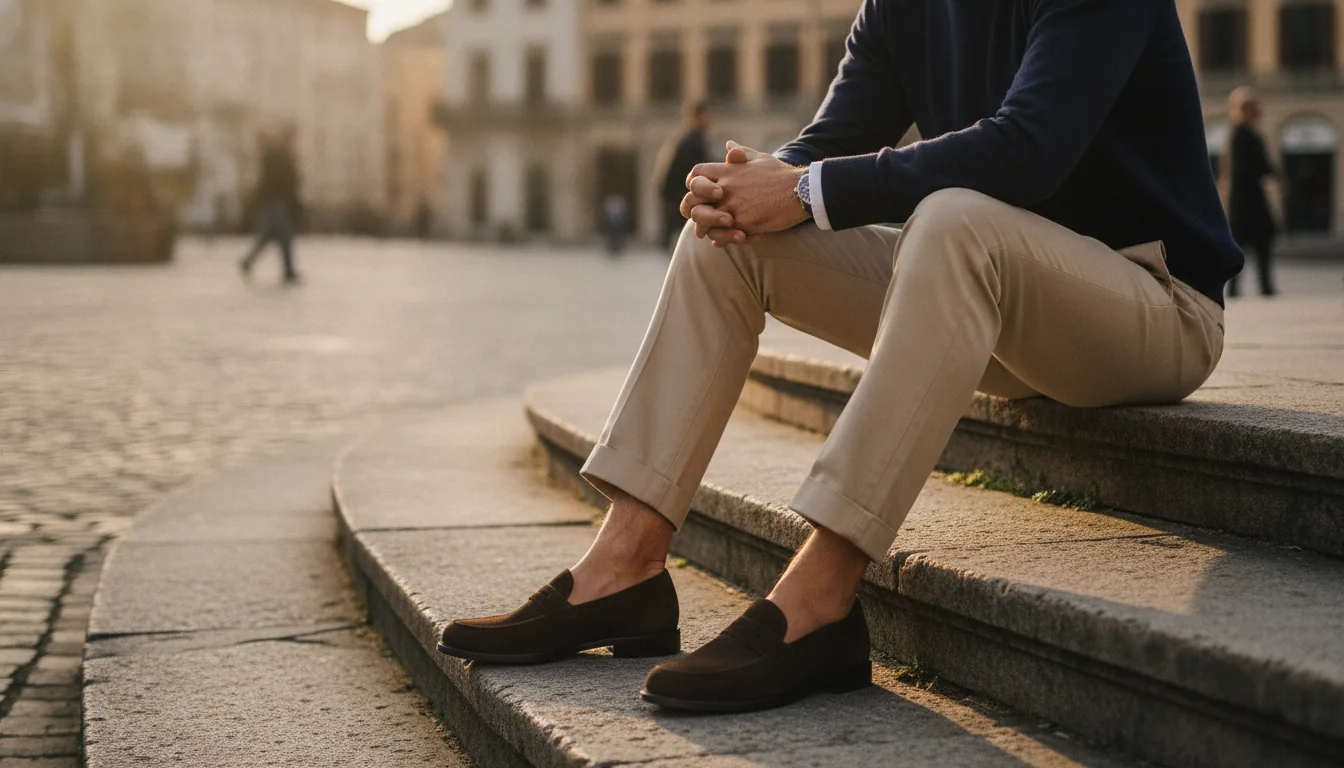
| Shoes | suede loafers | Chelsea boots, derbies with rubber soles |
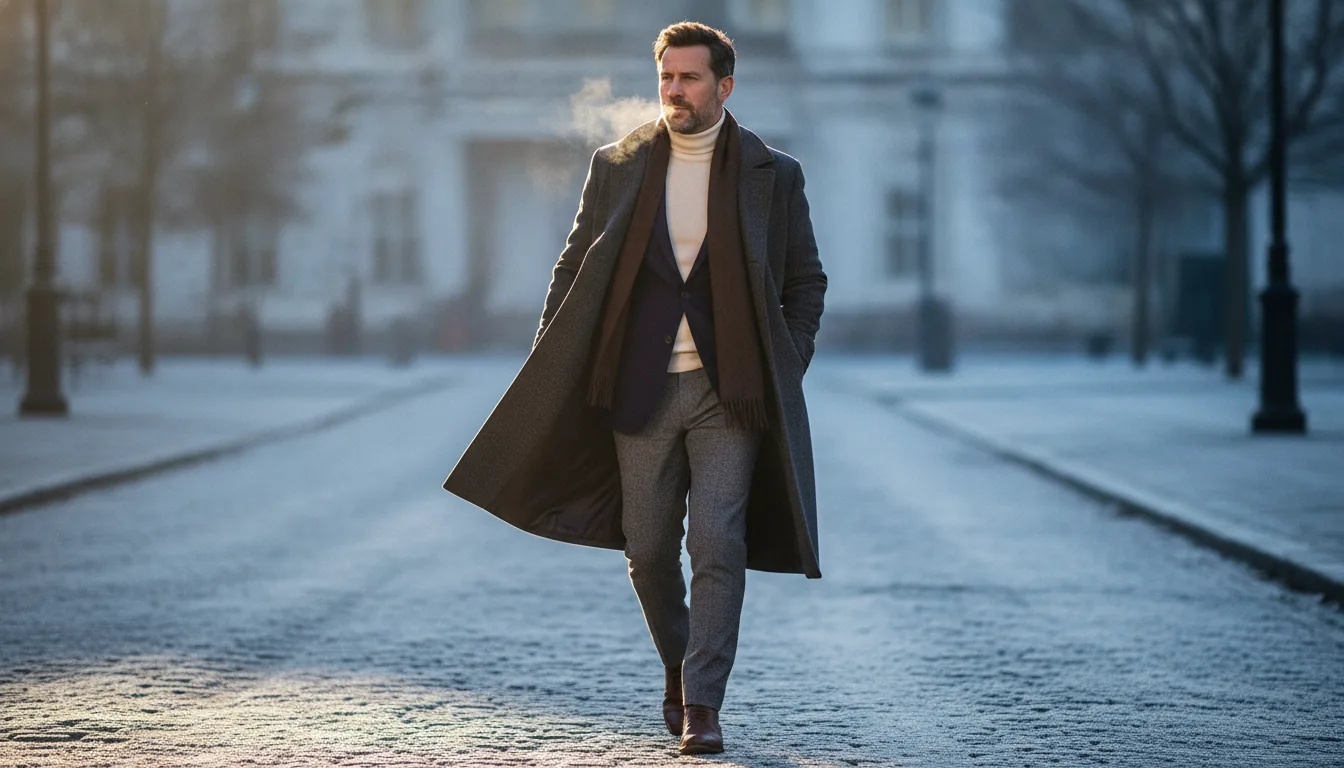
In winter, the coat joins the outfit. A wool topcoat in navy, gray or camel goes over any business casual look. A sporty puffer over your blazer turns a client day into weekend wear the moment you walk in.
Three signals that make business casual look too casual
A business casual outfit rarely fails because of a single piece. Usually it’s small details that add up. Three signals catch colleagues’ and clients’ eyes first.
- A collar that disappears under the blazer. Without a tie, your collar needs structure. Soft, unlined collars fall flat and make the outfit look tired. Button-down and spread collars hold their shape.
- Shoes that need care. Worn-down heels and dull leather stand out more in a meeting than a missing blazer. Fifteen minutes of shoe care on Sunday covers the week.
- A belt in the wrong color. Brown shoes, brown belt; black shoes, black belt. The rule costs nothing and makes the outfit look intentional.
Plan your workweek ahead
Business casual asks you for a small decision every morning: Which level fits today? Five workdays add up to five of those decisions per week. Make them all on Sunday and every morning starts without the guesswork.
In the AI outfit planner maiasa, you take one photo of each piece, and the AI recognizes and sorts it into your digital closet. A large AI language model, Google Gemini 3, then curates an outfit every day from the pieces you own, matched to your style and the weather. You can plan outfits days ahead. With the client meeting on Monday and the presentation on Wednesday, you assign both blazers to the right days and see right away which shirt needs washing first.
Full disclosure: I built maiasa myself. The app is developed in Germany and is GDPR compliant. The free version includes every feature; the only limit is swiping, at one outfit suggestion per day. Premium with unlimited suggestions comes with a 7-day free trial.
The bottom line: Business casual means a collared shirt, chinos or wool pants, a blazer and leather shoes, no tie. Your calendar picks the level, and a blazer at the office saves every surprise client meeting.
Frequently asked questions
What is business casual for men?
Business casual is an office dress code one step below a suit. Typical pieces are a collared shirt, chinos or dress pants, a blazer or fine knit and leather shoes. The tie is optional or left off entirely, and the outfit should still hold up in a client conversation.
Do you wear a tie with business casual?
Usually not. The Emily Post Institute lists the tie as optional for business casual, and most offices treat an open collar as the default. If you add a tie for an important meeting, you're moving toward business professional.
Are jeans business casual?
It depends on your employer. The Emily Post Institute says jeans are usually a no for business casual, yet dark jeans with a collared shirt and blazer are common in tech, agencies and many smaller companies. On a client day, chinos or wool pants are the safe call.
What shoes are business casual for men?
Leather shoes are the safest choice: derbies, brogues and loafers in brown or dark brown. Chelsea boots in smooth leather or suede work in fall and winter. Clean white leather sneakers pass in many offices, but they are too casual for client meetings.
Is a polo shirt business casual?
Yes, the Emily Post Institute includes polo shirts in business casual for men. A knit polo or a solid piqué polo without a big logo works best, especially on internal days and in summer. For presentations and client meetings, a collared button-up shirt is the better choice.
Sources
- The Emily Post Institute: Business Casual 101: Everything You Need to Know, Emily Post, accessed October 2, 2026
- Megan Brenan: Casual Work Attire Is the Norm for U.S. Workers, Gallup, September 8, 2023
- Levi Strauss & Co.: Dockers and The Birth of Casual Fridays, Levi Strauss & Co., July 7, 2014
- The Emily Post Institute: Attire Guide: Dress Codes from Casual to White Tie, Emily Post, accessed October 2, 2026
All links checked on October 17, 2026.